

You’ve done the clamshells. You’ve spent hours foam rolling your IT band until your legs are bruised. You’ve stretched your hip flexors religiously, yet that deep, pinching ache in your hip or groin just won’t quit.
If this sounds familiar, you aren’t “bad at stretching” and your hip isn’t “broken.” You’re likely just targeting the wrong victim. For many active women, the hip joint is simply the collateral damage of a much deeper issue: a tight or dysfunctional pelvic floor.
The Anatomy Connection: The “Door Frame” Problem
To understand why your hip hurts, we have to look at the Obturator Internus. While it sounds like a character from a sci-fi novel, it’s actually a powerhouse muscle that serves as a literal bridge between your worlds. It attaches to the inside of your pelvis and travels out to the back of your hip.
Because of this unique real estate, when the pelvic floor is tight, it pulls directly on the hip joint.
Think of it this way: Your pelvis is the foundation of your house. If the foundation is pulling too tight on one side, the door frame (your hip joint) isn’t going to swing open smoothly. No matter how much you oil the hinges (or stretch the hip), the door will still stick until you fix the foundation.
 4 Signs Your Hip Pain is a Pelvic Floor Problem
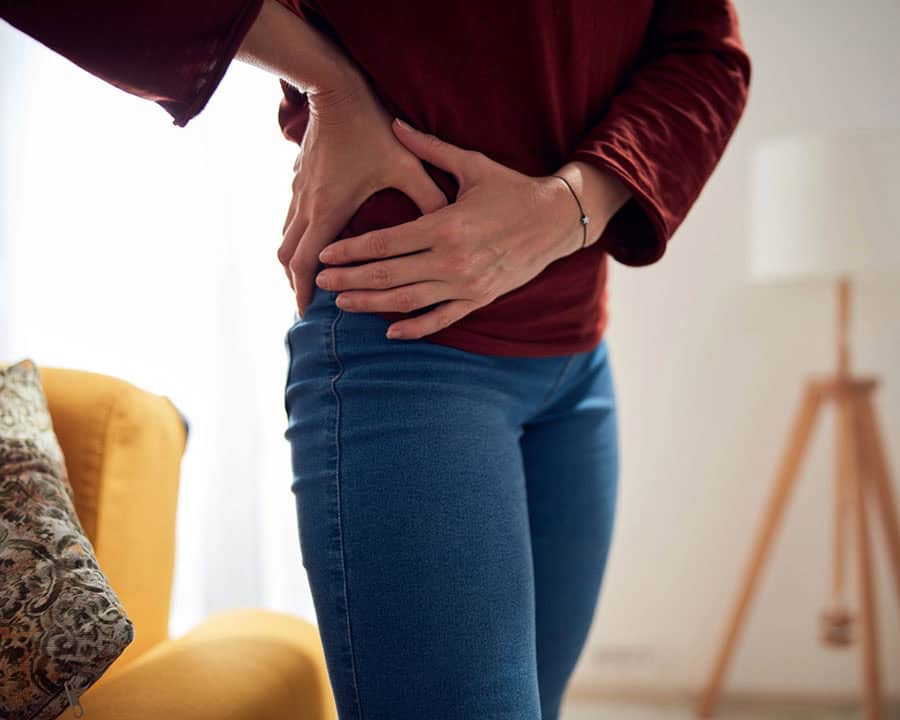 4 Signs Your Hip Pain is a Pelvic Floor Problem
If your “hip pain” is actually pelvic floor hip pain, standard orthopedic exercises often fail to provide long-term relief. Check if you resonate with any of the following:
-
The “Pinch”: Your pain is felt deep in the groin or feels like a sharp pinching sensation at the very front of the hip.
-
The Stretch Paradox: Classic hip openers (like Pigeon Pose) actually make you feel tighter or more uncomfortable afterward.
-
The Silent Symptoms: You’re dealing with hip pain alongside tailbone tenderness, painful sitting, or discomfort during intimacy.
-
The Exercise Flare: You notice occasional bladder leakage specifically when your hip pain flares up during a run or workout.
How Specialized Physical Therapy Fixes It
Standard physical therapy often stops at the joint itself—focusing on glute strength and hip mobility. While those are important, they don’t address the internal tension pulling on the system.
At PRO Therapy, our specialists provide physical therapy for pelvic pain that evaluates the whole system. We don’t just look at the hip; we look at the foundation. Sometimes, this tension even occurs
Treatment involves releasing that tension from the inside out. By calming the pelvic floor, we allow the hip to finally move the way it was designed to—without the constant “tug-of-war” from the inside. If you suspect your hip issues are connected to your pelvic floor, our
Stop Stretching. Start Healing.
Stop trying to stretch a muscle that doesn’t want to be stretched. It’s time to find the root cause of your hip and pelvic pain and get back to the activities you love without the “pinch.”
Book a discreet, 1:1 evaluation at our

- Why Your Stubborn Hip Pain Might Actually Be a Pelvic Floor Problem - April 13, 2026
- Dry Needling vs. Cupping: Which is Best for Your Chronic Muscle Pain? - April 1, 2026
- A Guide to Safe Postpartum Recovery and Rehabilitation in the Twin Cities - December 4, 2025