One of the biggest objections to Physical Therapy we hear on a regular basis is “I’ve already tried PT before and some stretching and exercises haven’t helped me”. We hear this phrase on almost a weekly, if not daily, basis from family and friends and people calling into our clinic looking for advice. Our response to them, “Great! Now we know what doesn’t work.” Far too often Physical Therapy gets summarized as a quick meeting with someone who provides you with a handout of exercises to “fix” your pain or problem.
At PRO Therapy, our goal is to provide SO much more than a brief exercise routine for the clients that we work with. We love exercise, but we also love to provide an experience that is so much more than a stretch or two. One intervention that we have had great success with is Dry Needling. Whether you are very familiar with Dry Needling (maybe you read our Dry Needling 101) or have never heard of it but are curious if it can help you and your pain, this blog is for you!
Here is a quick summary of just a few common conditions we treat with Dry Needling:
Is Dry Needling the same as Acupuncture?
Now that we have established who can be helped with Dry Needling, let us get into the most common question we hear regarding this tool. “Is Dry Needling the same as Acupuncture?” Our short response to this is, “No.” As Physical Therapists, we utilize the same tools as Acupuncturists, but we are not Acupuncturists and do not perform Acupuncture. So, the needles are the same, but the techniques are very different. At times we will be working with clients who are receiving Dry Needling from us and Acupuncture from an Acupuncturist at the same time. The techniques and goals behind the treatments are so different people can be receiving both for the same condition.
What is Dry Needling?
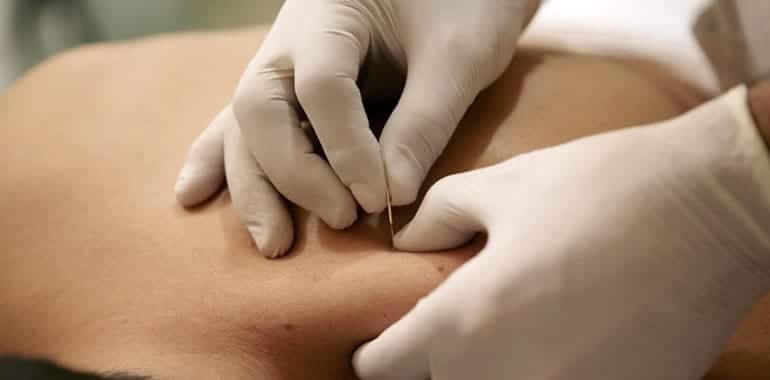
Dry Needling can be summarized as the use of a thin needle to penetrate the skin to stimulate underlying myofascial trigger points for pain management and problems with normal body movement patterns. In other terms, a very small needle is used to target tissue we believe is contributing to your pain and problems. The “Dry” in Dry Needling is because there is no medication on the needles. And when we say small needle, we mean it. These needles are much smaller than any needle that is used for “shots” or used to draw blood.
One of the big differences between Dry Needling and Acupuncture is how we select the location of where the needles will go. With Dry Needling, we are locating trigger points or areas within the muscle tissue we believe are not functioning appropriately. The needle is then inserted into that trigger point to in a sense “reset” that muscle tissue. Typically, when we have muscle tissue that is causing pain it is not contracting and relaxing the way it should. The stimulus produced from the needle can help get that muscle tissue back to its normal state so it can contract and relax appropriately. In some cases, Dry Needling locations can be as simple as touching the location of pain and inserting the needle directly at the source of pain.
What are Trigger Points?
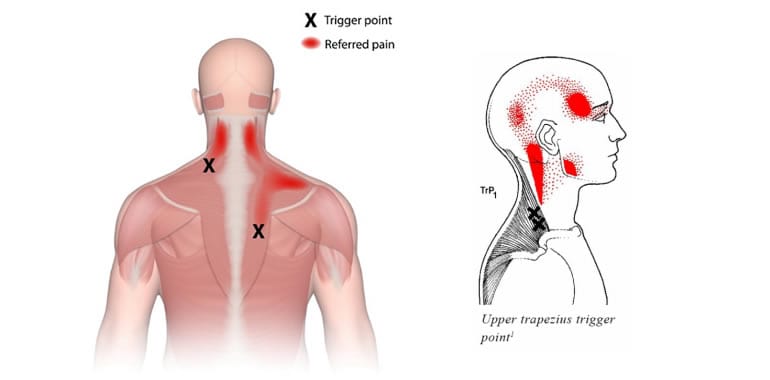
Think of this as the “knots” of muscle tissue you can feel with your hands. They usually feel stiff and are tender to the touch. We often look to this area to test whether that muscle is performing optimally. When you apply pressure to this area it may cause your pain. At times you might notice that the muscle tissue that feels “knotted” is not directly located to your pain location. This is because trigger points can refer pain to other locations in the body. Here are some common locations of trigger points near the neck and the pain they can refer.
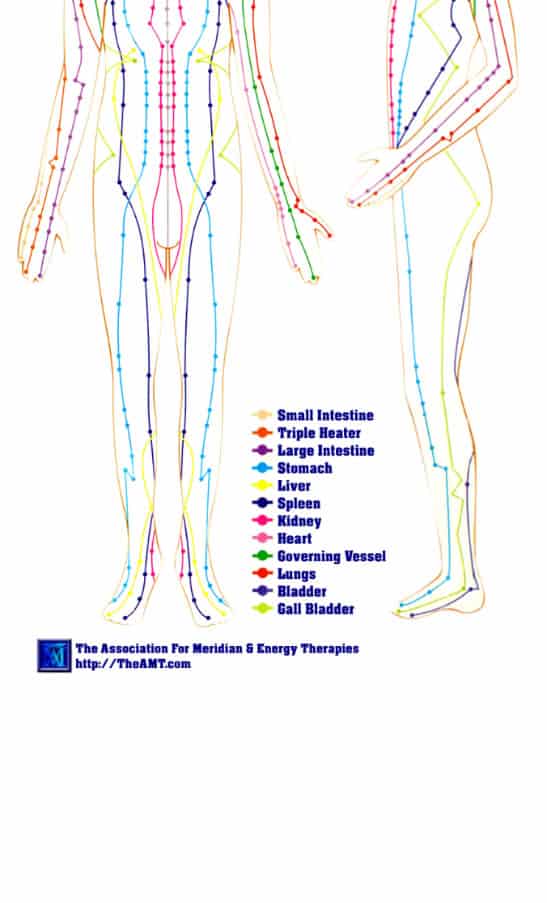
With Dry Needling we are often talking to clients about muscle tissue. It is a technique that more times than not will be targeting muscles. Dry Needling is very musculoskeletal based regarding needling location and the physiology we are trying to change with the needle. Now, an Acupuncturist will also select needling locations based on muscle tissue, but they are also using meridian points/meridian lines and chi to select needle locations. Qi or Chi (pronounced Chee) is described as the energy flow within our body that runs between meridian points. Acupuncturists may also rely on oral and aural (mouth and ear) diagnoses to guide their needling techniques.
What are the goals of Dry Needling?
First and foremost, we are using the needling to have a positive and at times immediate impact on your pain levels. The key here is to reduce “your pain”. That means we are utilizing the needling techniques to reduce the pain that you sought us out for. Typically, after Dry Needling you will feel some muscle soreness at the location of the needling but that is usually accompanied by a reduction in the original pain levels. A good “post workout” soreness is how most folks will describe how their muscle feels after a session of Dry Needling.
Another category of goals and how we will determine a successful response from Dry Needling is, your body’s movement. If we find an area of muscle tissue that is tight and restricting your movement, we will complete some needling at that muscle and immediately test to see if that muscle is less tight and allowing for greater range of motion. The response is not always immediate and may take a few sessions, but your range of motion and movement efficiency will be assessed after every needling session because we are expecting it to change. Strength testing before and after needling is also another outcome we will be tracking to in regards to improved muscle performance.
At the end of the day, Dry Needling is just one of MANY tools at our disposal to get you better. We will always start with your most important goals. Whether it is working your 9-5 desk job with less neck pain, returning to running with less pain, or being able to bend your knee again to get up/down the stairs, Dry Needling can often fit into your Physical Therapy plan of care. As Physical Therapists, we can’t forget the most important part of our jobs is helping people move better. So incorporated with every Dry Needling session is some form of movement to coincide with the needling. Dry Needling is typically the tool used to get some upfront pain relief so you can exercise with less discomfort.
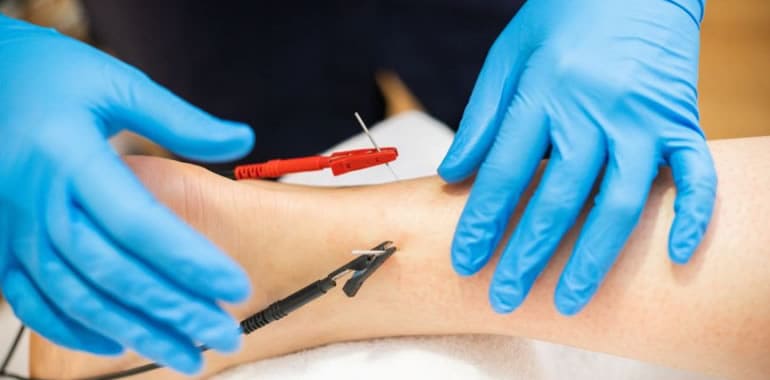
What does Dry Needling look like in practice?
It depends! The Dry Needling treatments are always going to be tailored specific to your pain and your complaints. So the treatments are truly unique every time we perform it. Typically, for your first 1-2 Dry Needling sessions we keep the volume of the needling relatively low (maybe 1-3 needles). At first the needles are in for a few seconds and out right away. If you are comfortable with the treatment we will progress from there. Based on your diagnosis we could Dry Needle multiple muscles during one session to get the results we are looking for.
There can be a large variety in what a Dry Needling session may look like. For some, it can be one needle placed at a trigger point for 3-5 seconds and if we are pleased with the stimulus created from that needle, we conclude the needling and get to other treatments planned for that session. In some cases, we may use 10+ needles placed into the muscle tissue to passively sit for 5+ minutes to induce the response we are looking for. We at times also add some extra “juice” to the treatment by using electrical stimulation with the Dry Needles to further excite or inhibit the muscle tissue.
This is probably a good time to bring up another common question we hear regarding Dry Needling, “Does it hurt”? Our quick and short response is, no. Can it be uncomfortable? Yes, most would use that word to describe it. The needles get placed into muscle tissue, so you can expect to feel muscle-related sensations (maybe a little achy and crampy). It all comes back to your pain and dysfunction. If the Dry Needling causes a little discomfort during the treatment session but helps reduce your pain when you are away from the clinic, we all look at that as success. The “hurt so good” phrase is used quite often during a needling session.
In Conclusion….
Trigger point therapy has been around for 50+ years and Dry Needling at trigger points has been utilized in therapy for 30+ years. The pool of research supporting it’s benefits for people in pain continues to grow. If you have more specific questions regarding Dry Needling and how it may help you, give us a call at (612)767-9917. We offer FREE Phone Consultations as well as FREE Discovery Visits with our Doctors of Physical Therapy to discuss your concerns and goals.

- 5 Signs Your Pelvic Floor May Need PT - October 15, 2026
- When Kegels Aren’t Working – Pelvic Floor Therapy for Active Women - October 4, 2026
- Can Shockwave Therapy Fix Chronic Back Pain? - September 28, 2026