
When you are dealing with pelvic pain, bladder leaks, or postpartum core weakness, asking for help can feel incredibly daunting. Many women avoid seeking treatment simply because they don’t know what to expect. The idea of a pelvic floor evaluation sounds intimidating, leading too many active women to just accept their discomfort as “normal.”
At PRO Therapy, our goal is to completely demystify this process. Seeing a women’s health physical therapist shouldn’t be scary or mysterious.
It is a highly clinical, empowering experience designed to give you back control of your body. Here is exactly what happens behind closed doors during a consultation, and how we help you return to the active life you love.
What Actually Happens During a Pelvic Floor Evaluation?
Your initial assessment is entirely focused on uncovering the root cause of your symptoms. We move at your pace, and you are always in the driver’s seat regarding your care.
Here is the three-step process you can expect during your first visit:
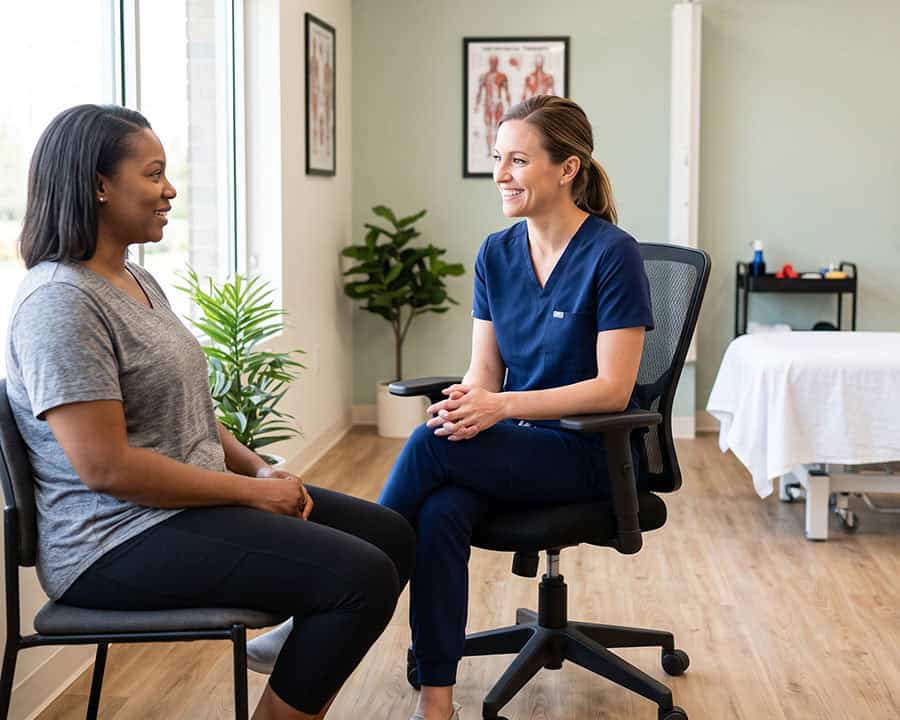
Step 1: The Conversation. We start by simply sitting down and talking. We want to know your health history, when your symptoms flare up (like leaking during double-unders or pain while running), and what your specific athletic or lifestyle goals are.
Step 2: The External Assessment. Your pelvic floor does not operate in isolation. We perform a full-body movement assessment to check your breathing mechanics, hip mobility, core stability, and spinal alignment to see how they impact your pelvis.
Step 3: The Internal Assessment (With Consent). With your explicit permission, we may perform an internal musculoskeletal exam. This is the gold standard for accurately diagnosing whether your pelvic floor muscles are too weak, too tight, or lacking coordination.
When Should You See a Women’s Health Physical Therapist?
You do not have to wait until your symptoms are severe to seek help. Professional physical therapy is highly effective for both active rehabilitation and injury prevention.
It is time to book an assessment if you are experiencing:
Leaking during impact: Losing urine when you sneeze, cough, run, or lift heavy weights.
Pelvic or pain with intercourse: Experiencing a deep, aching pain in your pelvis, hips, or lower back, or pain during sex (dyspareunia).
Heaviness or pressure: Feeling a dragging sensation or a noticeable “bulge,” which are common signs of pelvic organ prolapse.
Postpartum recovery issues: Struggling with abdominal separation (diastasis recti), core weakness, or painful C-section scar tissue.
 Quick Answers About Pelvic Floor Physical Therapy
 Quick Answers About Pelvic Floor Physical Therapy
Does a pelvic floor exam hurt?
No, a pelvic floor exam should not be painful. While you may feel some light pressure or muscle tenderness when the physical therapist assesses tight trigger points, the evaluation is gentle and always guided by your comfort and explicit consent.
Do I have to have an internal exam at pelvic floor PT?
No, an internal exam is never mandatory. While it provides the most accurate clinical picture of your pelvic floor muscle strength and coordination, our physical therapists can also successfully assess and treat your core using highly effective external evaluation techniques.
How long after birth should I see a pelvic floor physio?
You can typically begin specialized pelvic floor physical therapy around four to six weeks postpartum, once cleared by your physician. However, even if you gave birth years ago, it is never too late to start rehabilitating your core and resolving pelvic dysfunction.
Take the First Step Toward Confidence
You deserve to train, run, and live your life without constantly mapping out the nearest public restroom or worrying about pelvic pain.
If you are ready to take control of your core health, our doctoral-level specialists are here to help. Book a discreet, 1-on-1 evaluation for specialized pelvic health physical therapy in Minneapolis or schedule with a women’s health physio in Coon Rapids today.

- What Does a Women’s Health Physio Actually Do? (And When Should You See One?) - September 16, 2026
- What is StemWave Therapy? (And How It Differs from Traditional Shockwave) - September 7, 2026
- Pelvic Floor PT for Active & Postpartum Women - August 29, 2026